Trending

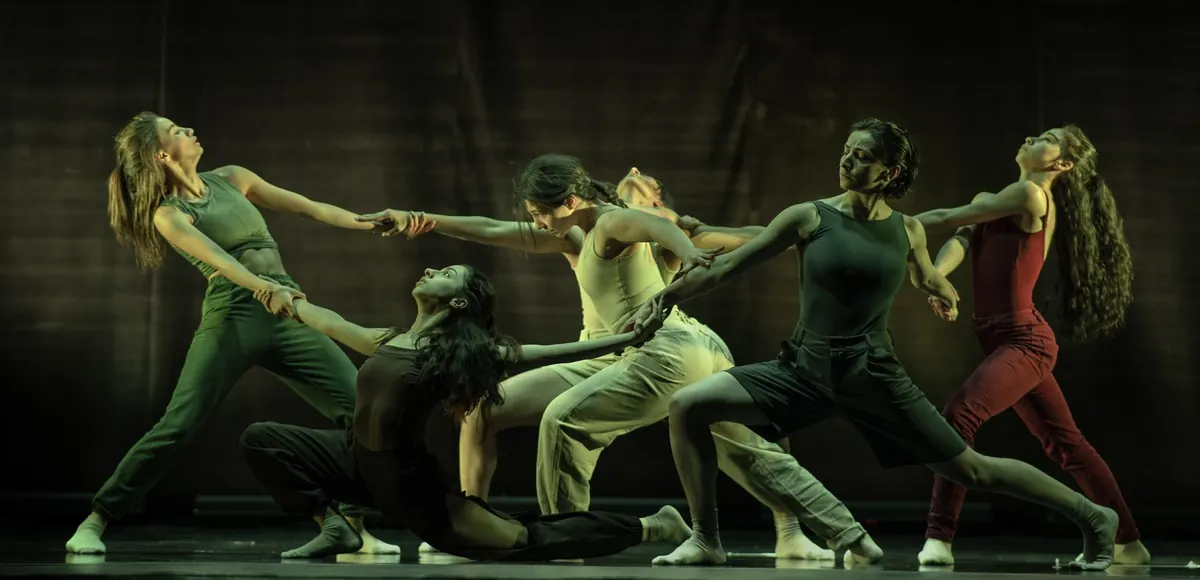
You know the moment. Two performers stand a metre apart, and one raises a hand. Nothing has been said, but the room has changed: something has been asked for, refused, or lost. That small transaction — body to body, watched by an audience — is where physical theatre does its work. It is theatre that trusts movement, gesture, weight and the ensemble to carry meaning, and it is one of the most accessible and demanding forms on stage today.
If you have ever left a show and found you could not describe the plot properly, but could still feel the shape of it in your shoulders, you have probably seen some. This is a beginner's map.
Physical theatre is not a genre in the way a musical or a farce is. It is closer to a method of making: a set of priorities. The body is treated as an author. Text may be present, sparse, or absent entirely, but it never sits alone at the top of the hierarchy. Design, sound and light usually behave as performers rather than decoration.
That is why two shows described as physical theatre can look nothing alike. A Frantic Assembly production bristles with lifts and club energy; a Complicité piece might hinge on a single chair and a tangle of microphones. What they share is a rehearsal room where the question is not "what does the character say next?" but "what does this look like, and what happens in the space?"
Traditional drama asks an audience to follow language. Physical theatre asks you to read a body. That reading is not mystical; it is built from a few concrete elements you can learn to notice.
Weight tells you who holds power. A performer leaning forward, pelvis low, is asking for contact. A performer shifted back on the heels is refusing it. When two actors share weight — one takes the other's forearm, one carries the hips — the audience instantly understands trust, dependence or coercion.
Rhythm tells you what is at stake. Repetition creates pressure. A gesture done once is information; done twelve times, it becomes obsession. Ensemble sequences that accelerate do the work that a crescendo of dialogue would do in a naturalistic play.
Scale and direction tell you who is looking at whom and who is winning. A single performer facing the back wall while the ensemble faces front changes the temperature of a scene. It is a compositional choice, like a wide shot in film.
It helps to separate two things. Movement is the large architecture: travelling, falling, rising, grouping. Gesture is the small, precise, often repeated detail — a hand to the throat, a flick of the wrist, a tap on the sternum. Good physical theatre sets a few bold gestures early and then reuses them so that by the final scene a single flick of the wrist lands like a line of dialogue. Watch for that recycling. It is where the craft hides.
Most physical theatre is devised rather than written, and it is usually made by a group in a room. That changes what you see. Performers must be able to improvise, catch, lift, and — crucially — be interesting while doing nothing.
Ensemble work produces recognisable stage patterns:
A practical note for anyone making work: an ensemble needs rules more than it needs ideas. Agree on how long a sequence lasts, who can speak, and what the group does when someone makes a mistake. Those agreements are what make spontaneous stage pictures look intentional.
Two confusions come up constantly.
It is not simply dance. Dance theatre and physical theatre overlap, and the boundary is genuinely blurry — Pina Bausch's Tanztheater sits on it. But physical theatre usually keeps narrative, character and text in play, and it rarely asks performers to be technically virtuosic dancers. A performer who can commit to a fall convincingly is more useful than one with perfect turns.
It is not mime either. Mime, in the classical tradition, pretends objects exist and asks you to see them. Physical theatre more often asks you to see the relationship between bodies, using whatever is on stage — a table, a door, a wall of light — as a partner rather than an illustration.
Rather than reading about it, watch it. These are useful starting points, and most companies tour internationally and have video material online.
The British company founded by Simon McBurney is the best-known bridge between text and movement. Mnemonic builds whole journeys out of a long table and a chair; The Encounter puts the audience in headphones and makes a binaural recording feel like a physical presence in the room. Watch how props become landscapes.
Known for fast, athletic partnering in work like Beautiful Burnout. Their appeal for beginners is clarity: the movement vocabulary is legible, the stories are recognisable, and their rehearsal methods are widely published, which makes them a good company to study if you want to try the work yourself.
DV8 Physical Theatre built a reputation for physical work that interrogates masculinity, sexuality and social pressure. Gecko, a smaller UK company, uses a highly visual, dreamlike style with strong design — a good example of how scenography can carry as much narrative weight as a script.
Belgian company Peeping Tom works in an unsettling, almost cinematic register where rooms tilt and props misbehave. Theatre Re's The Nature of Forgetting turns memory loss into duets and support work. Across all of these, the through-line is not style but method: the body is in the room before the script is.
Audiences often feel they are missing something. You are not — but a small shift in attention helps.
You do not need a dance background. Start with two exercises, run for ten minutes each. First, walk the space in a group and let one person change the speed; everyone else follows without discussion. Second, stand opposite a partner and try to move them across the room using only eye contact and your own weight shift, without touching. Both expose how much negotiation is already happening between bodies.
Then add a rule: no one may speak for five minutes, and something must change in the room. Improvise around that constraint and record it. What you will notice on playback is that the clearest moment came from a decision about distance or timing, not from an idea. That is the habit to build.
Finally, go and see the work live when you can. Physical theatre is unusually hard to judge from clips, because its meaning lives in a shared room — in the breath of a performer three metres away, in the silence before a lift. The form rewards attention more than knowledge. You already know how to read a body. The show is simply asking you to do it on purpose.
Photo: Ernest Ghazaryan / Pexels