Trending

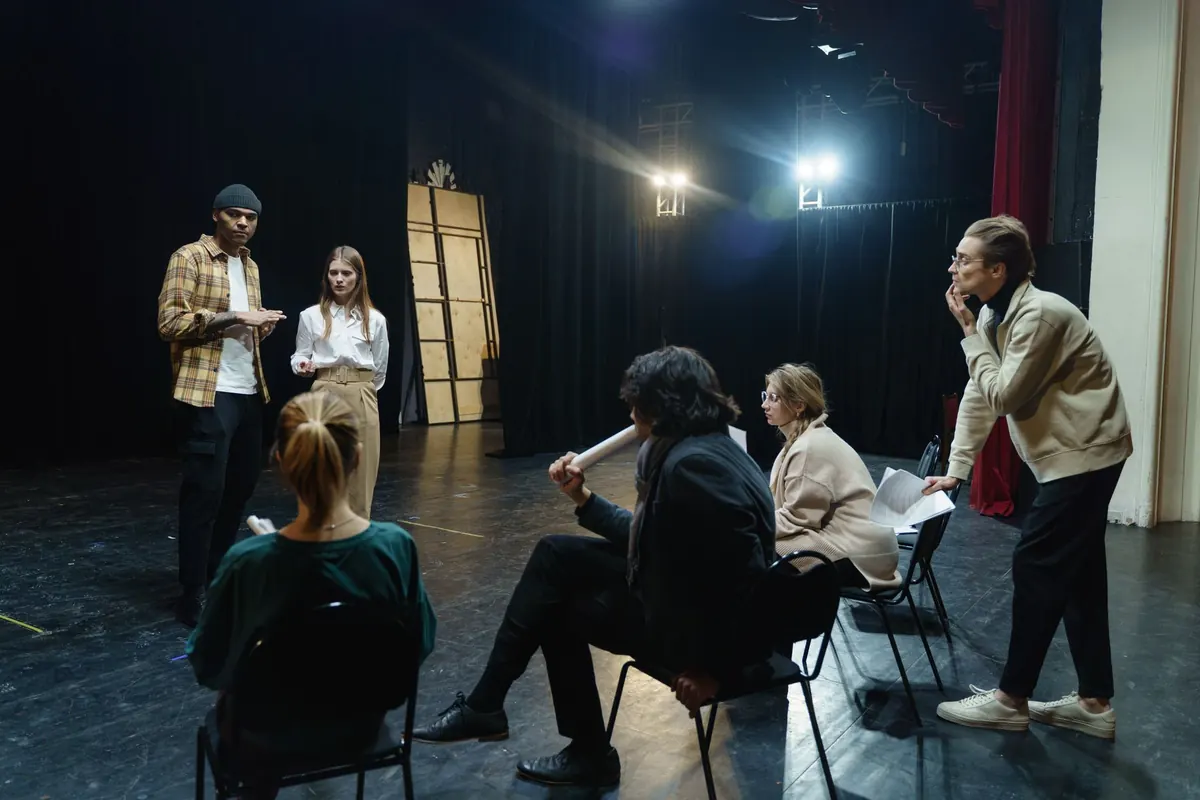
Most theater begins with a text. Someone writes it, someone else directs it, and the cast spends weeks asking what the playwright meant by that line in act two. Devised theater reverses the order. A company starts with a question, a photograph, a piece of music, a stubborn argument nobody can settle — and the script, if a script ever exists, arrives at the end.
That reversal is thrilling and unnerving in equal measure. On the first day there is no scene to learn and no authority to say "that's not what the line means." There's a room, a group of people, and an agreement to find out what the show is by making it. For beginners, the freedom is the hardest part. What follows is how ensembles actually turn that freedom into structure.
Devised work is created by the people performing it, rather than interpreted from a pre-existing play. The text may be a transcript of what was said in the rehearsal room, a score of tasks and cues, a collage of interviews, or nothing written at all. "Devised" describes a method, not a genre — devised shows can be comic, political, physical, documentary, or all four at once.
It's also older than it sounds. Commedia dell'arte troupes worked from scenarios and built dialogue on their feet; physical theater companies have long composed through bodies rather than pages. What distinguishes contemporary devising is the emphasis on shared authorship: the performer is not executing someone else's vision but contributing to the composition.
One clarification worth making early, because beginners trip over it: devising is not the same as improvising. Improvisation is a tool you use during devising, and it can also be a performance form in its own right. Devising is the slower, less glamorous work of selecting, arranging, and rehearsing what the improvisation produced.
A weak starting point is a topic. A strong one produces behavior. "Climate change" gives a group almost nothing to do; "what would you take if you had ten minutes to leave your home" gives them a hallway, a suitcase, and a set of impossible choices. Aim for the second kind.
A question the group genuinely can't answer. Not a rhetorical question, and not one with a correct response. If everyone already agrees, there's no friction to build scenes from.
Source material that resists summary. Court transcripts, letters, instruction manuals, voice memos, a box of family photographs. Documentary material gives you specificity — odd phrasing, real hesitations — that invented dialogue rarely matches.
A constraint. Six chairs and no words. Everything happens in a waiting room. The show runs twelve minutes and repeats twice. Constraints feel limiting on day one and become the show's signature by week four.
Whichever you choose, write it on the wall. Groups drift, and a visible prompt keeps the work from turning into a series of unrelated good ideas.
Treat early improvisation as fieldwork. You are collecting material, not auditioning for laughs. That shift in mindset matters: performers who think they're performing try to be clever, and cleverness is usually the least useful thing in the room.
Keep the frames small and the rules few — one rule per improvisation is plenty. Give the scene a clear who, where, and what, set a three-to-five minute limit, and stop while it's still going. Then talk. Record everything: a camera in the corner, a notebook, or both. Memory is generous and unreliable, and the gesture you can't quite recall is often the one worth keeping.
Two etiquette notes for newcomers. Don't direct from inside a scene — if you have an idea, save it for the conversation afterward. And don't block: if someone hands you an invisible cup, take it and drink. The habit of accepting offers is what makes the research productive.
Around week three, every devised show hits the same crisis: too much material, no shape. The wall is covered in notes, three scenes are good, and nobody can say what connects them.
Start by transcribing. Watch the footage, write down what happened in plain language, and tag each fragment with a verb — persuades, waits, confesses, cleans. Verbs reveal patterns that descriptions hide. If six fragments involve someone waiting, you may have found your spine.
Then test each fragment against three questions:
Build a spine before you build a plot. A repeated action, a recurring sound, or a progression from one physical state to another can hold an evening together more securely than a storyline. Sketch the order on index cards and be willing to throw cards away. Most devised shows lose a third of their good material in the edit, and they are better for it.
Collective creation sounds democratic and often becomes slow. Someone needs to run the session, someone needs to watch, and someone needs to write down what was decided. These can be different people, and the roles can rotate, but they need to be filled.
An outside eye is worth arranging early — a director, a dramaturg, or a trusted colleague who drops in every couple of weeks. Performers inside the work lose perspective fast. A fresh observer can tell you that your opening ten minutes are incomprehensible, which is exactly what nobody in the room wants to hear and everybody needs to.
Keep a running document of decisions: what's in, what's out, what's still open. Devised rehearsals generate strong opinions and weak memory. Writing it down prevents the same argument from returning every Thursday.
You don't need a year and a budget to learn how devising works. A small group, a regular weekly slot, and a low-stakes sharing at the end will teach you more than any amount of reading.
The first devised piece is rarely the one you imagined, and that's the point. The skill you're building isn't knowing what the show should be — it's trusting the process enough to find out, and disciplined enough to cut what doesn't serve it.
Photo: cottonbro studio / Pexels